About induced labour
25% of all pregnant women in Denmark are induced. There can be many different reasons why we recommend inducing labour. The most common reason is going past your due date. Other reasons include pre-eclampsia, diabetes, high blood pressure, twin pregnancy, or a suspicion that the baby is not growing as expected.
There are different methods of inducing labour, and usually a combination of methods is used. The method depends on how ready your body is to give birth. Induced labour can result in Braxton Hicks contractions. Despite the pain and discomfort they cause, they do not actually mean labour has begun and they can increase the need for pain relief. It may take anything from a few hours to several days for the birth to start. As a general rule, the shorter and softer your cervix, the faster the birth will begin.
Sometimes induced labour does not begin within the desired timeframe. In this situation, you and the doctor will discuss what to do next. Together with your doctor, you will decide whether to keep working on inducing labour, whether to take a break for a day, or whether you should have a caesarean section.
Cervical ripening | Membrane sweep, medication, cervical balloon catheter |
Induction | Puncturing the amniotic sack.
Regular contractions begin, possibly with the help of a synctocin drip. |
Active labour | The cervix expands.
You push the child out. |
You have an appointment for induced labour at Akut Modtagelse for Gravide, G0131 (emergency admissions for pregnant women, G0131) on____day, __ /__ - 20 __ at __:__
Contact us if you begin having contractions or if your water breaks before the appointment.
We will examine you before inducing labour
Before inducing you, a midwife will use her fingers to check how long and open your cervix is. This will help her decide which method of induction is most appropriate.
An ultrasound will be done to make sure your child’s head is in the correct position.
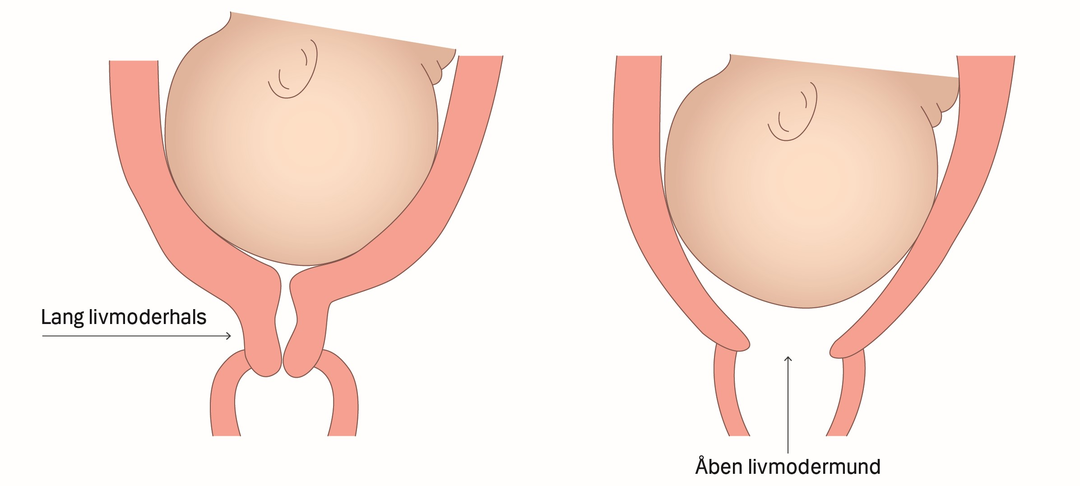
Membrane sweep
If your cervix is shortened, the midwife can use her fingers to loosen the lower part of the amniotic membrane from the wall of the cervix. In some cases, this can cause contractions to begin.
Some women find the procedure uncomfortable and it can result in some bleeding and cause more Braxton Hicks contractions.
Different methods of inducing labour
Cervical balloon catheter
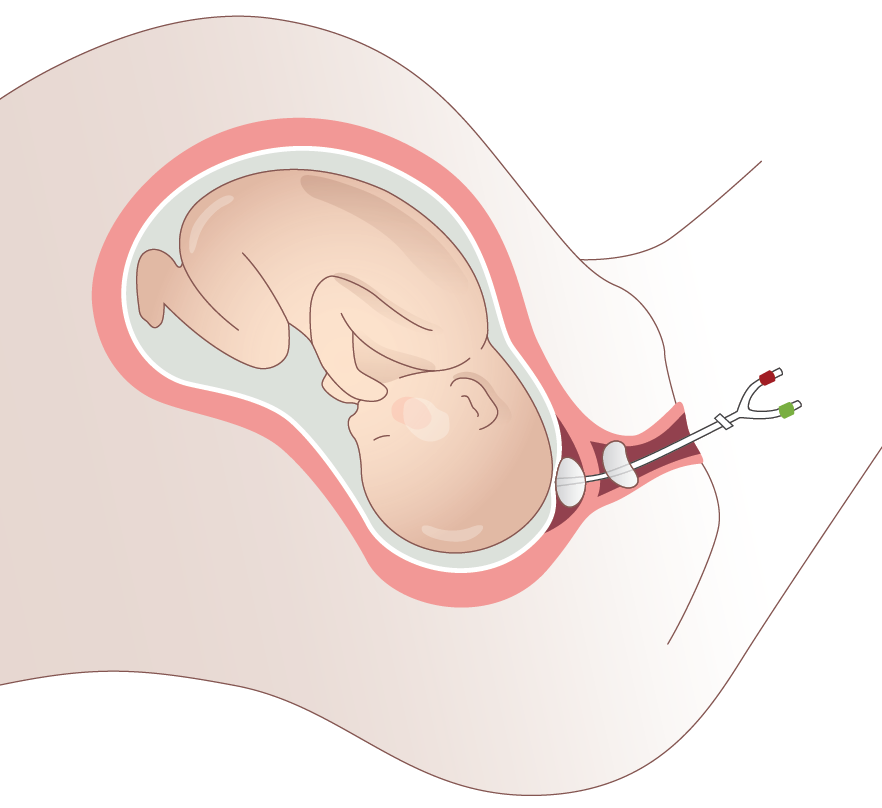
If your cervix is fixed and closed, we recommend having a cervical balloon catheter inserted into your cervix. A cervical balloon catheter is a soft silicon tube with two balloons at its end. The balloons are filled with saline fluid and they put pressure on the cervix to ripen and soften it.
The catheter must remain in place for approximately 12 hours. When the catheter is removed, it is usually possible to puncture the amniotic sack.
Some women find insertion of the catheter uncomfortable, and some experience period-like symptoms or Braxton Hicks contractions afterwards. In some cases, inserting the catheter causes contractions to begin.
Puncturing the amniotic sack
Once the cervix has shortened and your uterus has begun to open, the midwife can puncture the amniotic sack. This may feel uncomfortable for you, but your child will not feel a thing.
We will ask you to walk around a bit after we puncture the amniotic sack. This can help start contractions. If your contractions do not begin within one to three hours, we will usually give you contraction-inducing medication via an IV drip.
If your child's head is not positioned correctly in the pelvis, in rare cases the umbilical cord can drop past the child’s head when the amniotic sack is punctured, which will then affect the child’s heart rate. If this happens, an emergency caesarean section will be necessary.
Contraction-stimulating medication
If your contractions do not begin or are too weak, we can give you medication to stimulate them. The medication will be mixed with saline solution and administered via an IV drip in your hand. The IV drip is slow, and we can increase the amount gradually if needed to ensure suitable breaks between contractions. Once the contractions become stronger, your uterus will begin to open. How long it takes the medication to work varies.
There can be side effects such as nausea, vomiting, headaches and palpitations. The medication can also cause contractions to come very quickly. We can slow the IV drip or stop it completely to regulate the rate of contractions.
We will monitor your child's heart rate and examine you regularly
We will closely monitor your child's heart rate during the birth using either CTG or STAN registration. A CTG registration requires wearing two belts around your stomach, each belt will have a monitor attached. One monitor registers your child’s heart rate and the other registers the contractions in your uterus.
If your water has already broken, we will monitor your child’s heart rate using STAN. A belt will placed around your stomach with a monitor to register contractions. A small electrode will be attached to your child’s head.
Postponing induction
We usually induce labour on the date agreed. However, we may have to postpone your induction of we are too busy to give you the best possible care and monitor you closely. This will only be done if it is safe to do so. If the induction is postponed, we will offer you a check-up at emergency admissions for pregnant women using a CTG machine and an ultrasound.
Learn more
Learn more about inducing labour by watching this video on our website: www.regionh.dk/32o (in Danish only).